

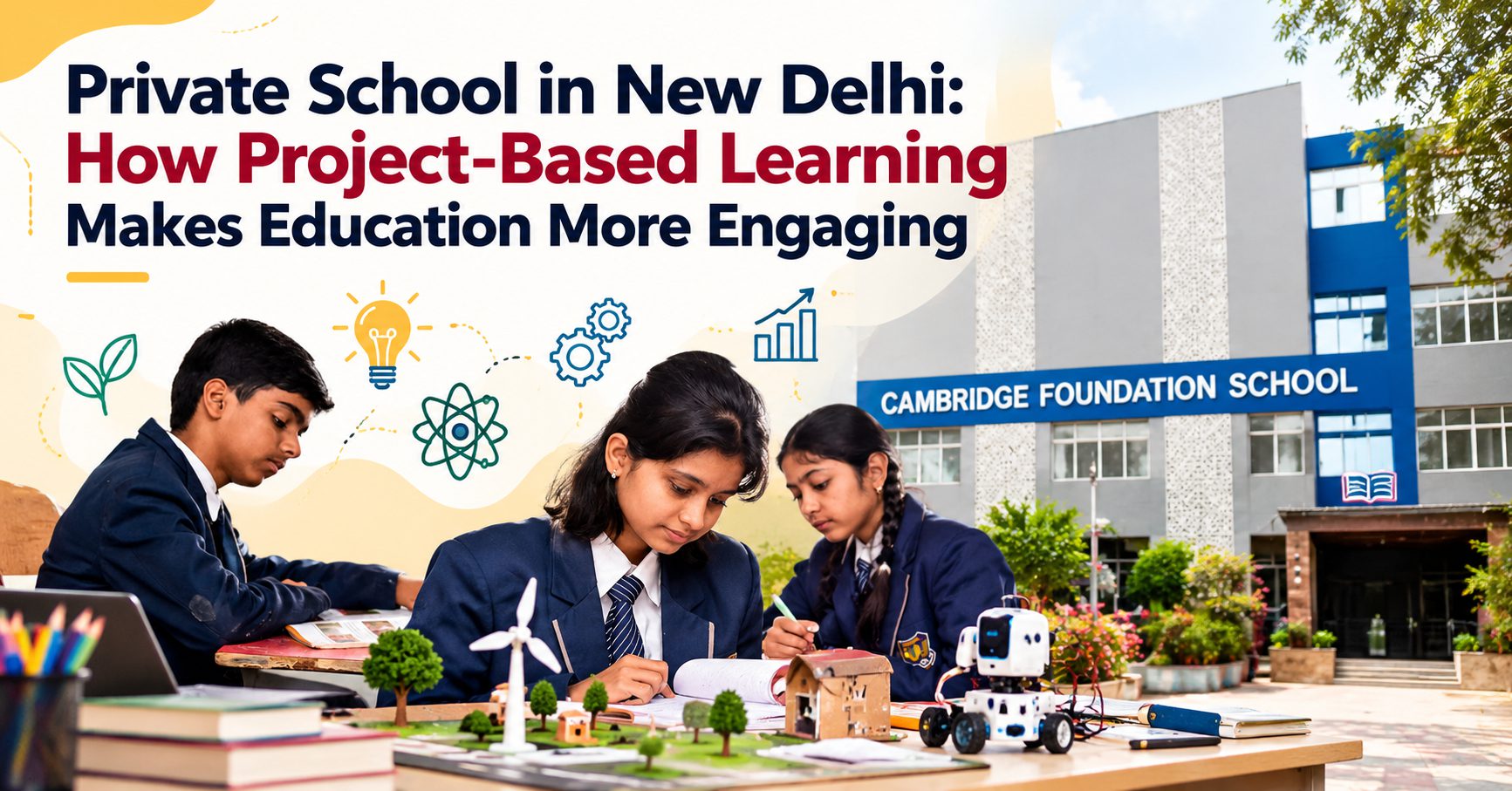
Student learning is better when they are provided with chances to use the ideas they have learned outside the limited world of textbooks and the repetitive homework. Project based learning provides opportunities for students to explore topics, to solve real-world problems and to produce products. This can be a way for a private school in New Delhi to create more interactive learning environments and provide students with academic and hands-on experience.
Relate classroom concepts to real-world situations
Projects can serve as a means to demonstrate to students the application of that theoretical learning outside of the classroom, while traditional lessons will be used as a means to provide students with important theoretical knowledge. For instance, if the project is a science project, the students can watch a process as it unfolds, can gather data and draw conclusions based on that data.
Likewise, projects can be based on research, surveys, presentations or real-life examples in subjects like mathematics, social science or languages. This can help students to better understand and remember concepts.
Encouraging Active Participation
The process of project learning involves students in learning from start to finish. Students might be required to research rather than listen to a lesson or fill in a worksheet, to organise their ideas, to solve problems and to present what they have learned.
A private school in New Delhi can include individual and group projects in various subjects, allowing students to be actively involved in their learning. These activities can also help students to develop an appetite for questions and ideas about things that are important to them.
Creating Research and Problem-Solving Strategies
Projects often start with a question or problem to explore. The ability to locate information, compare information and make decisions about how to present information can assist in the development of research skills.
Pupils can also meet with difficulties on a project which may necessitate a redesignation of strategy. Overcoming these challenges can help develop problem-solving and decision-making skills that are applicable beyond the classroom.
Development of collaboration and communication
Group projects can offer a chance for students to interact with fellow classmates who might think differently and work in a different way. Students learn to divide responsibilities, discuss their views and work towards a shared outcome.
Other methods for developing communication skills include presentations and project demonstrations. Research and answer questions about a project will involve students getting their thoughts organised and communicating them clearly.
Fostering creativity and independent learning
Projects can give students the opportunity to take an approach to a topic that is different from what they have been given. They can develop models, presentations, reports, experiments, digital content, or other forms of work, depending upon the assignment.
This flexibility can foster creativity, while providing autonomy for students in the learning process. Teachers will continue to guide but students will be able to learn how to plan tasks, time and complete work on their own.
Creating more meaningful assessment activities
Project-based activities may be used as an add-on to traditional assessments. Teachers may assess the conceptual understanding, research and problem-solving, and communication skills of students.
In a private school in New Delhi, one can adopt project work as an alternative to tests, assignments, and class room activities to have a wider perspective on the student learning. A feedback throughout and after projects can enable students to identify their strengths and identify areas for improvement.
Therefore, project based learning can transform the learning process into an interesting learning process because it is able to link the concepts taught to practical activities. Appropriately integrated into the curriculum, it can foster engagement and promote research, communication, collaboration, creativity and problem-solving abilities that will serve students well on the way to further learning.
